


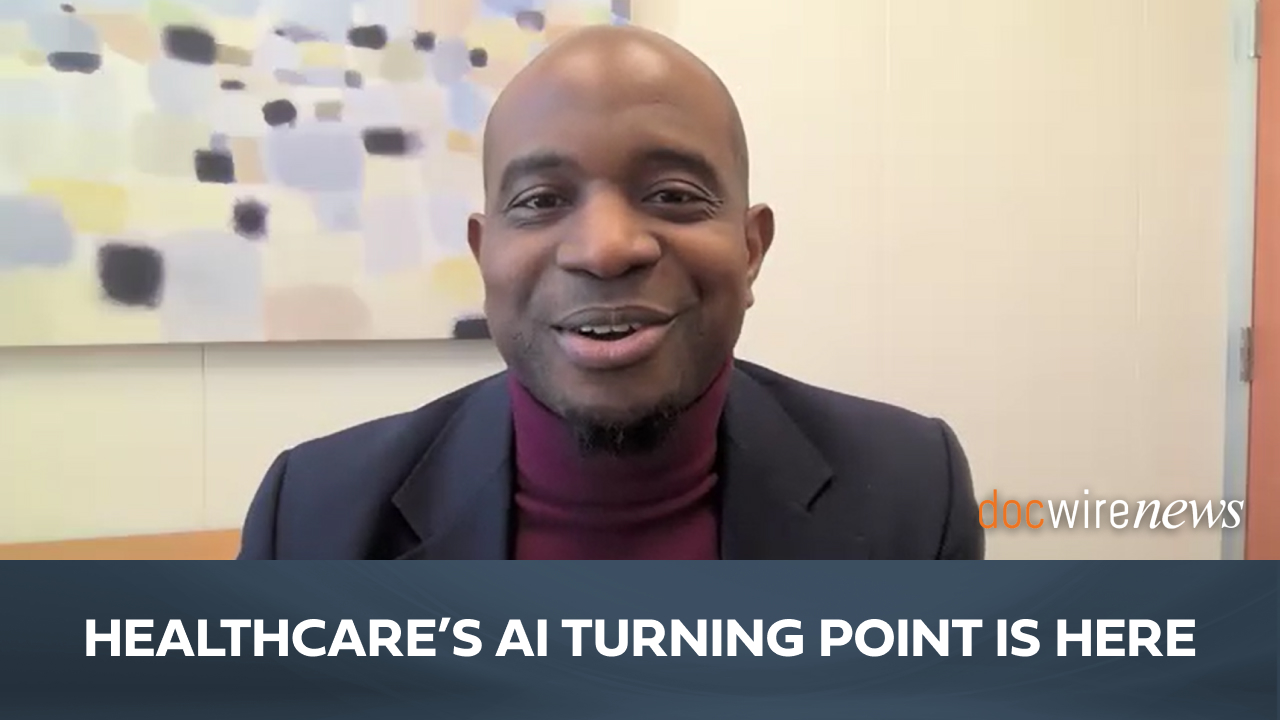
In this interview, Azizi A. Seixas, PhD, of the University of Miami Miller School of Medicine, explores how fragmentation in data, workflows, incentives, and governance has slowed the adoption of artificial intelligence (AI) in healthcare. He emphasizes that the next 5 years are critical for the digital transformation of healthcare, driven by the convergence of maturing technologies, clinician burnout, and economic pressures. Dr. Seixas also shares a case example—the Virginia Mason Production System—that healthcare leaders can look to when considering how to adopt and scale an AI transformation at their own organization.
Dr. Seixas is an associate professor of psychiatry and behavioral sciences and director of the Media and Innovation Lab. In addition to these roles, he is also associate director of the Center for Translational Sleep and Circadian Sciences and interim inaugural chair of the Department of Informatics and Health Data Science.
–
This transcript has been edited for clarity.
How does fragmentation impact the adoption of AI in healthcare?
Dr. Seixas: I think there are four places where fragmentation has the biggest impact on tech adoption. The first is really around data fragmentation, where the patient data lives across multiple spaces: electronic health records (EHR), devices, imaging systems, wearables, and claims. And when that data can’t flow, then AI really can’t see the full patient story. That really limits everything, from prediction all the way to personalization, which I think is really the holy grail of patient care experience.
The second area is more so around workflow fragmentation. Many people in healthcare systems feel this, and actually, patients feel this as well. Because far too often, when we digitize a broken process—whether we want to add a dashboard, alerts, or portals—without actually redesigning how care actually happens, what ends up happening is that you have more clicks but not necessarily more care. That’s a major driver of clinician frustration, and we see this often.
A third area is around incentive fragmentation. Many of these promising digital tools, from remote monitoring to AI triage or even asynchronous care, can work best between visits, but reimbursement still largely rewards visits and documentation. So having an in-person synchronous experience is oftentimes privileged and rewarded. I think that misalignment can slow adoption [regardless of] if the technology works or not.
Then the last one—which I think is even more critical, because it helps control the other areas—is governance fragmentation. For example, decisions about AI, privacy, security, and operations are often siloed to different departments across an entire healthcare system. They don’t really talk to each other, and they don’t provide a fully integrated operational system. That can lead to slow approvals and inconsistent standards. Quite frankly, clinicians may feel tremendous mistrust.
So the key point is that digital tools don’t necessarily fail because they’re immature. I think they fail because they are introduced to fragmented systems without alignment, and I think that is where the critical issue is.
Why are the next 5 years key to the digital transformation in healthcare? How can organizations capitalize on this moment?
Dr. Seixas: I truly believe that [over] the next 5 years, we have a critical and decisive window for real healthcare transformation, in part because there are three forces that are potentially converging, but if we don’t act now, they will diverge, unfortunately. First, we are at a stage of more technology maturity, where general-purpose technologies or accelerated-purpose technologies, like artificial intelligence or remote monitoring and digital diagnostics through digital biomarkers, are no longer experimental. They’re actually ready for operation. Many people contend that we are still in that pilot phase, but some of us believe that we’re moving away from the pilot phase, where people want to see real implementation in systems. I think that is where we are right now.
Then the second force is around workforce pressure, where one real keyword is burnout. Burnout remains a very important critical issue. It’s reported that over 40% of physicians report burnout symptoms. It is said that “pajama time” on average is about 108 minutes, where providers have to spend additional time outside of clinic to do necessary patient work. Healthcare simply cannot function if we keep adding administrative work. This is where I believe technology has to reduce burden, not add to it.
And then the third force—which could potentially be convergent, but if we don’t see the right leadership right now, is going to be an issue—is economic pressure. What we are seeing now is that as health system margins are becoming tied up, and systems are being pushed toward efficiency, accountability, and value, inefficient care models are just no longer sustainable.
So, how do organizations capitalize on this? This requires an institutional-level intervention, where the biggest mistake is buying technology first. Instead, leaders should, I believe, pick two or three high-volume pathways.
Let’s say, for example, an area that I focus on, hypertension follow-up, diabetes management, or post-discharge care—we can redesign any of those pathways end-to-end. I’ll give you a concrete example—hypertension. So, typically today, a patient is seen, labs are ordered. Follow-up is oftentimes delayed, unfortunately, and worsening blood pressure is discovered, maybe months later, after an emergency department visit. … If we were to redesign the pathway, it would look completely different. We can stratify risk at the visit. We can deploy home blood pressure monitoring, which we do in a lot of our work, where we build our own remote health monitoring solution.
Then, you can have AI filter the data. Clinicians can triage and see exceptions, and not the noise. That’s a big thing that you want to be careful of. A lot of people will say, “Hey, if you use more devices, it means you have more data.” But my clinician and friends will oftentimes say, “Well, not all of those data are actionable.” [In the updated care pathway,] you may have someone from the treatment team, whether it be a nurse or a navigator, respond first after AI filters through the noise. Then you may have a physician who escalates, only when needed. Then the loop is closed with maybe automated documentation and patient messaging. Then you still haven’t digitized the visit, you’ve digitized the interval between visits, and I think that is the key.
So if institutions miss this moment, they don’t just move slower. They get locked into legacy workflows, and then vendor choices as a result, and therefore are forced to transform later under crisis conditions rather than strategic ones.
What can the Virginia Mason Production System teach healthcare leaders about system-wide technology adoption?
Dr. Seixas: I think that dovetails nicely to what I had alluded to first. This is a powerful example of getting this [transformation process] right, long before the AI hype.
Virginia Mason faced many of the same challenges healthcare faces today. This is a hospital out in the Seattle area, where they had issues around safety concerns, inefficiency, rising cost, and staff frustrations. Instead of starting with technology, they adopted principles from a Toyota production system. And so it then became the Virginia Mason Production System, and they have an institute now.
Their focus was on flow reliability and waste reduction, all really viewed from the patient perspective, because that’s how you become customer/patient-centric. They mapped care processes end to end, and they standardized the work. They eliminated rework and delays, and they built a culture of continuous improvement. And then, only after achieving process clarity, that is when they added technology to come in. I think this is why the Virgin Mason framework became this national model—not because of a tool per se, but because of an operating system they built.
And so that’s the lesson for healthcare, and it’s quite profound: Operational excellence is a prerequisite for digital excellence. That is the most important thing that you can learn from the Virginia Mason Production System model.
What vision for tech adoption should leaders take to successfully transform their systems and practices?
Dr. Seixas: I think the vision leaders and clinicians should adopt is that technology is clinical infrastructure, not innovation theater. Technology should make care simpler, safer, and more continuous. AI should support professional judgment, not replace it. And success should be measured by outcomes and experience, not just adoption or dashboards.
To make it easier, I usually use this acronym FLOWS. You want to first fix the flow before buying tech. That’s F. L is you want to lower clinician burden. O is operationalize AI inside the workflows. And then the W is work as teams, not silos. And then the S stands for the scale that works. If technology doesn’t improve flow, then it’s just not transformation.
What’s the one move healthcare leaders can make today to jump-start digital transformation?
Dr. Seixas: It’s important to just pick one clear pathway. It’s important that folks focus on what the process is. I would bring together what I consider an ecosystem stakeholder map, bring them into a room, and spend about 90 minutes mapping [workflows] end-to-end. This is where you can see where information is lost, where decisions stall, and where you can do a lot of the reworking. Then just test one digital intervention, just one, that removes friction. Then measure the results in 30 days. These are sprints. Then you will see that transformation doesn’t start with buying the software. It starts with clarity about care and how care should flow. I think based on that, technology will then finally deliver on its promise.
link