



People love contests, with the twin motivators of fun and prizes. So it’s only natural that businesses use social media marketing tactics like running contests and sweepstakes to attract and engage potential customers. However, it’s crucial to be informed about the legal considerations involved with social media contests and giveaways, so you don’t unwittingly run afoul of the law.
We’ll explain the laws surrounding social media games and contests and share tips for running social media giveaways that bring positive attention to your brand.
What is a giveaway, sweepstakes or contest?
Before incorporating contests and sweepstakes into your marketing plan, understanding various game types is crucial:
- Lotteries: Lotteries are defined by having prizes, consideration (payment) and a “chance” to win, e.g., buying a ticket in hopes of winning millions in a state-run lottery. You can’t run an actual lottery as a social media game. These events are regulated heavily and reserved for state governments. Lotteries combine all three elements: payment, chance and prizes, making them illegal for businesses to operate.
- Sweepstakes: Like lotteries, sweepstakes are games in which people enter to win a prize. Winners are chosen randomly. Unlike lotteries, sweepstakes participants can enter for free. Sweepstakes are games of pure chance where winners are selected randomly from all eligible entries.
- Contests: Unlike lotteries and sweepstakes ― games of chance ― a contest awards prizes based on skill or merit, such as art contests, cookoffs or trivia contests. Because the element of chance is eliminated, companies can require consideration for entry into a contest (although some state laws prohibit this). However, even though entry requirements are somewhat relaxed when prizes are earned, not awarded, contests must also be administered within the confines of the law. Contests require participants to demonstrate skill, creativity or knowledge to win.
The key legal distinction is that removing any one of the three lottery elements (payment, chance or prize) makes a promotion legal for businesses to operate.
Key legal requirements every giveaway must meet
Social media games can help heighten buzz around your brand or product launch, generate sales leads and increase sales. However, business owners and marketing managers must familiarize themselves with the rules and regulations surrounding them. Every legitimate sweepstakes or contest must include these fundamental legal requirements:
- No purchase necessary: Federal law requires that sweepstakes be free to enter. Any requirement for purchase or payment transforms the promotion into an illegal lottery.
- Clear eligibility criteria: You must specify who can and cannot participate, including age restrictions, geographic limitations and employee exclusions.
- Defined timelines: You must clearly state entry periods, winner selection dates and prize fulfillment deadlines.
- Complete terms disclosure: By law in the U.S., you must list general rules, fine print and “terms and conditions” for your contests or sweepstakes. You could include details like “no purchase necessary,” the date when the winner will be chosen and notified, eligibility requirements and more.
“The absolute worst thing a company could do is assume there is no need for the fine print,” Mark Voronov, co-founder and CEO of SocialPlug, told us. “You may be shocked at the number of campaigns that are suspended due to not completely laying out and spelling out guidelines for eligibility, along with any prize tax details that might need to be included.” In certain states, like New York, you might be required to send your winner a 1099 the following January for taxes on the reward.
Alternative methods of entry (AMOE) explained

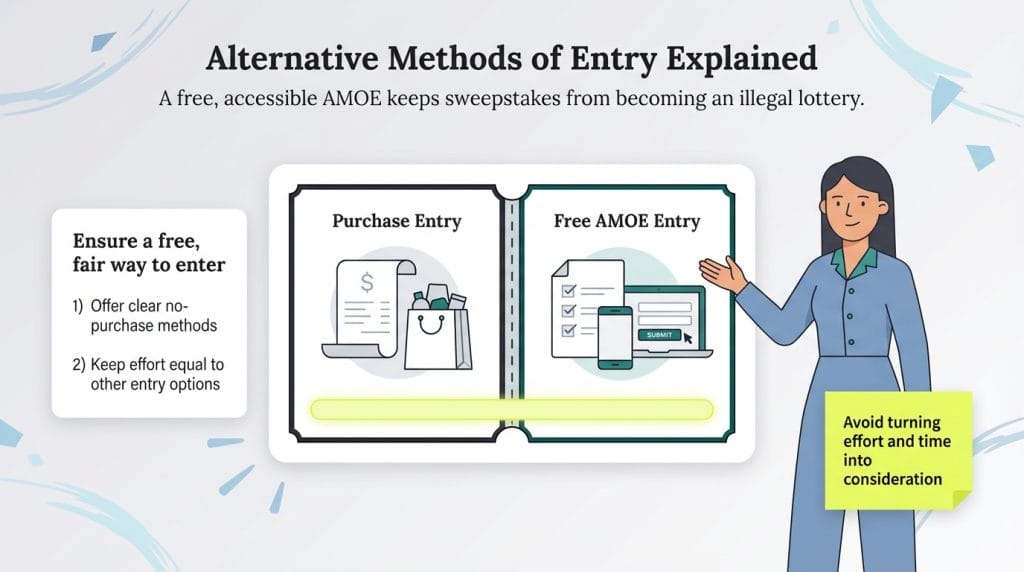
A free alternative method of entry (AMOE) is typically required for sweepstakes to avoid creating an illegal lottery. Many companies want to run sweepstakes for their current customers, so they give away an entry ticket with a purchase. However, since money is exchanged, there is consideration, which causes a problem. A popular way to circumvent the problem is giving people a free alternative way to enter with no purchase required.
Under most state laws, creating a free entry alternative makes the sweepstakes legal. Take McDonald’s. It can give away its McDonald’s Monopoly tickets to paying customers ― consideration ― because it also offers an alternative free method to enter the sweepstakes.
Common AMOE examples include:
- Mail-in entries with hand-written information
- Online form submissions without purchase
- Phone-in entries during specified hours
- In-store visits to complete entry forms
The AMOE must be equally accessible and not more burdensome than the primary entry method. Make entering your sweepstakes easy to avoid running into this problem, as money isn’t the only form of consideration. If a customer must put excessive effort into entering the sweepstakes, the work and time they put into the submission can turn into consideration.
State-specific sweepstakes rules you can’t ignore

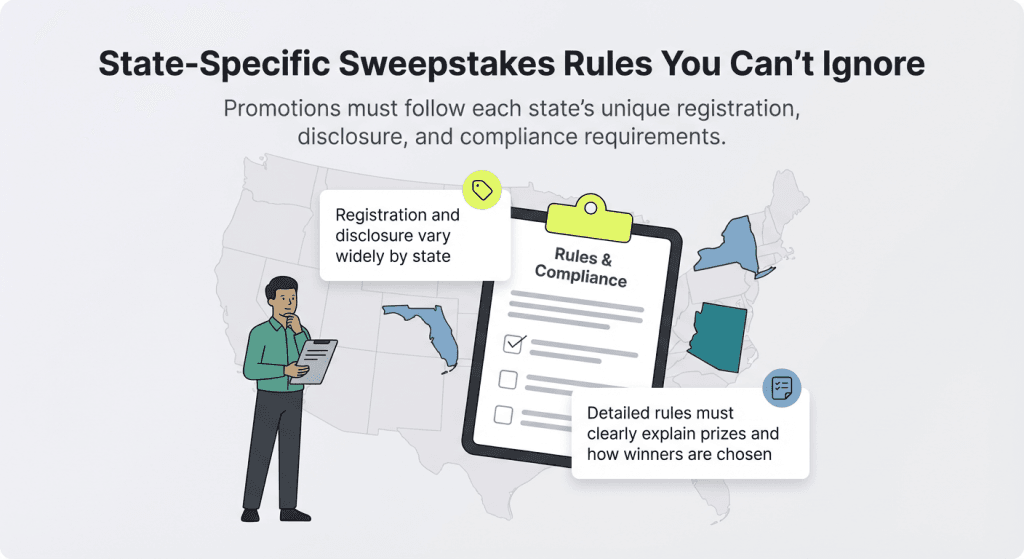
Complicating matters more is the fact that each state has its own set of laws governing promotions and each law is different.
Florida, New York and Rhode Island require sweepstakes offering prizes over a specific value to be registered. Similar laws also apply to contests, especially if a purchase is required to enter. Arizona requires the company to register the contest with the attorney general’s office, including a sworn statement that no additional fee was added to the purchase price in connection to the contest.
Key state requirements include:
- Registration and bonding requirements for high-value prizes
- Specific disclosure language mandated by certain states
- Filing fees and administrative paperwork
- Ongoing compliance monitoring and reporting
Moreover, the official rules of the sweepstakes or contest must fully disclose information about the prize offerings, method of entry and selection of winners. These are samples of what may be required, so a company must always check the applicable state’s laws before engaging in a promotion.
Creating legally compliant rules for your giveaway
When it comes to contests and sweepstakes, businesses must clearly:
- Explain what the prizes are
- Announce the opening and closing dates for entries
- Disclose how winners will be selected
- Announce when prizes will be given out
- Contact all winners
- Actually give winners the prizes they are promised
All of these steps (except for the awarding of prizes) must be set up when the game is initially launched and the information must be available during the contest’s entire duration.
Essential rule components include:
- Liability limitations and indemnification clauses
- Tax responsibility disclosures
- Prize substitution rights
- Disqualification conditions
- Data collection and privacy statements
Failing to follow these rules can quickly backfire – as one Florida Hooters restaurant learned the hard way. In an effort to increase beer sales, the business ran a contest among its servers in which it promised the winner a new “Toyota.” However, on prize day, the employee was blindfolded, escorted to the restaurant parking lot and given a “toy Yoda.”
Unsurprisingly, the winner was unhappy. The worker quit and filed suit against the company to get the promised Toyota, alleging breach of contract and fraudulent misrepresentation. The server won, and Hooters purchased the former employee a new Toyota.
While this is an extreme example, it provides a cautionary tale demonstrating the importance of planning a contest before jumping in head-first with a giveaway. “Just avoid deception in any form,” Voronov said. “Don’t claim [a] $5,000 gift card as money that will change someone’s life unless that truly is what you are trying to claim.”
Common mistakes to avoid in sweepstakes compliance

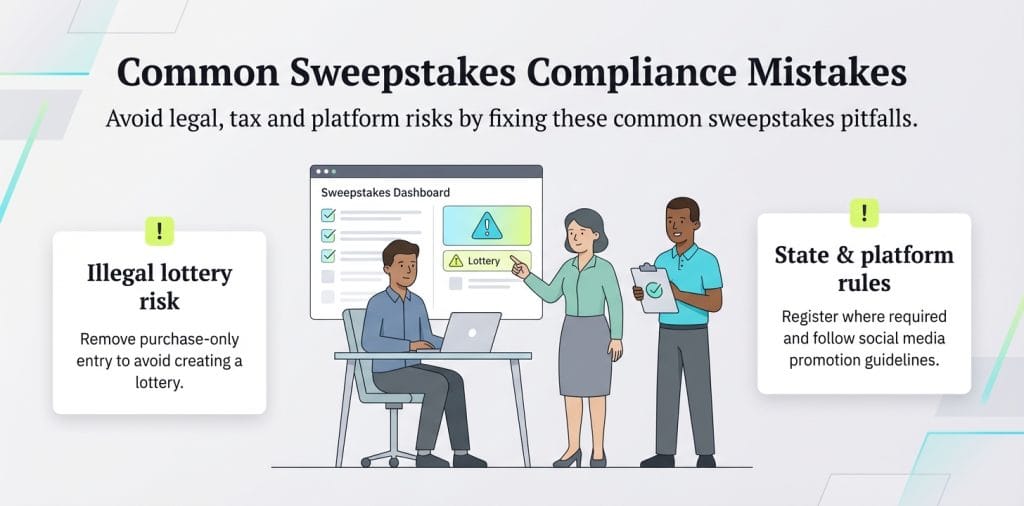
These compliance pitfalls can result in legal action, fines or forced contest cancellation:
Creating illegal lotteries
Ensure you don’t run an illegal lottery. Lotteries are games reserved for state governments to raise money for public initiatives like education. They’re considered a type of gambling. As such, they’re regulated heavily to help rein in gambling addictions and the devastating societal issues they cause. For these reasons, nongovernmental entities, including private businesses, can’t hold lotteries. To avoid an illegal lottery and run a legal contest or sweepstakes, a company generally must eliminate one of the three lottery elements (prize, consideration and chance). For example, a lawful sweepstakes typically will involve a chance to win a prize but doesn’t require consideration to enter.
Omitting AMOE requirements
Many businesses make the mistake of requiring a purchase for all entry methods without offering an alternative free entry option. This automatically transforms what should be a legal sweepstakes into an illegal lottery. Even if the AMOE is included, making it unnecessarily difficult or more burdensome than the purchase method can still create legal problems. The alternative entry method must be equally accessible and prominently disclosed in your official rules.
Ignoring state registration requirements
States like Florida, New York and Rhode Island have specific registration and bonding requirements for sweepstakes with prizes above certain thresholds. Failing to register can result in hefty fines and legal action from state attorneys general. Some businesses assume they only need to comply with laws in their home state, but they must actually follow the rules of every state where participants can enter. This oversight can lead to expensive legal battles and damaged reputations.
Platform rule violations
Abide by platform-specific rules for your contest or sweepstakes. Online legal complexities are not your only consideration. Most social media platforms, including Facebook and X (formerly Twitter), have specific guidelines in their terms of use that you must follow when conducting a promotion.
Typically, social platforms require acknowledgment that they don’t endorse, promote or administer the promotion. Specific platforms have their own rules, as well. For example:
- Facebook requires that all promotions be run through specific pages or apps, not on personal pages.
- X requires contests to discourage participants from creating multiple accounts and posting the same tweets repeatedly.
A business that ignores the rules or fails to abide by them could find its promotion suspended or, worse, its entire social media account deactivated.
If navigating various platform-specific rules sounds arduous, especially when running a promotion online is so easy ― that’s because it is. Despite low barriers to entry, the risks are real. However, while thoroughly vetting the legality of a contest or sweepstakes may seem costly, it’s usually worth it when you reap the rewards of increased online brand awareness.
Inadequate prize descriptions
Ambiguous language about prizes can create serious legal exposure, as demonstrated by the infamous Hooters “toy Yoda” case. Businesses must provide exact specifications, including model numbers, retail values and any limitations or restrictions. Failing to deliver prizes exactly as described can result in breach of contract lawsuits and consumer fraud allegations. Always be specific about what winners will actually receive, including any taxes they may be responsible for paying.
Missing tax compliance
The IRS requires businesses to issue 1099 forms for prizes valued at $600 or more, and some states have even lower thresholds. Many companies forget to collect winners’ tax identification information or fail to report prize distributions properly. This can result in penalties from tax authorities and angry winners who receive unexpected tax bills. Establish clear procedures for tax documentation before launching any promotion with valuable prizes.
Reference table: giveaway and sweepstakes legal checklist
Use this checklist to ensure compliance before launching your promotion:
|
Requirement |
Sweepstakes |
Contest |
Action Required |
|---|---|---|---|
|
No Purchase Necessary |
Required |
Optional* |
Include AMOE if purchase involved |
|
Official Rules |
Required |
Required |
Draft comprehensive terms |
|
Eligibility Criteria |
Required |
Required |
Define age, location, employee restrictions |
|
State Registration |
If high-value |
If high-value |
Check FL, NY, RI requirements |
|
Platform Compliance |
Required |
Required |
Follow social media platform rules |
|
Winner Selection Method |
Random |
Merit-based |
Document selection process |
|
Tax Documentation |
If applicable |
If applicable |
Prepare 1099 forms for valuable prizes |
|
Liability Protection |
Required |
Required |
Include limitation clauses |
*Some states prohibit consideration even for skill-based contests
link