
Digital technology impacts and JD-R model application
In recent years, a growing body of research has examined the psychological and behavioural impacts of digital technologies on employees, drawing on various theoretical perspectives such as the Conservation of Resources (COR) theory, Self-Determination Theory (SDT), the Technology Acceptance Model (TAM), and the JD-R model.
COR theory posits that individuals strive to acquire, retain, and protect valuable resources (Hobfoll 1989; Hobfoll et al. 2018). In the context of digital transformation, COR theory is often used to explain the processes of resource depletion (e.g., techno-anxiety, fatigue) and resource compensation (e.g., skill acquisition). For example, Ren et al. (2023) found that a high prevalence of digital connectivity increases emotional exhaustion, which in turn undermines employees’ work performance. However, COR theory tends to focus on how individuals cope with resource threats or losses, with relatively limited focus on mechanisms that stimulate positive motivation.
SDT emphasises the role of the work environment in satisfying individuals’ basic psychological needs for competence, autonomy, and relatedness (Deci and Ryan 2012). It is used to explain how digital technologies influence employees’ work motivation and well-being (Gagné et al. 2022b). For instance, Gagné et al. (2022a), drawing on SDT, found that algorithmic management negatively affects workers’ need satisfaction and intrinsic motivation. Nevertheless, SDT primarily focuses on intrinsic motivation and is less equipped to capture social comparison and competitive demands triggered by technology.
TAM is designed to explain individuals’ willingness and behaviour in adopting technology, highlighting the roles of perceived usefulness and perceived ease of use during the decision-making process (Davis 1989; Marangunić and Granić 2015). It is particularly suited to understanding the initial stages of technology introduction and adoption. For example, in the context of smart tourism, Cimbaljević et al. (2024) found that employees’ technology readiness affects their intention to use new technologies through perceived ease of use and perceived usefulness. However, TAM pays limited attention to the psychological and behavioural consequences following technology adoption, especially employees’ stress and adaptive behaviours during continuous use, which constrains its explanatory power regarding the long-term impacts of digital technologies on employee outcomes.
Compared to the other theories, the JD-R model provides a more comprehensive framework to simultaneously account for both the positive adaptive pathways and the negative defensive pathways activated by digital technology, while also incorporating the moderating effects of individual characteristics (Bakker and Demerouti 2017). Therefore, it offers a solid theoretical foundation for our study to explore the complexity of digital technology’s impact and the heterogeneity of employee responses.
Originally proposed by Demerouti et al. (2001), the JD-R model has become a widely used theoretical framework in the research on job stress and motivation. Its core assumption is that working conditions can be categorised into job demands and job resources, which affect employees’ psychological states and behaviours through distinct mechanisms. Job demands refer to physical, psychological, social, or organisational aspects of the job that require sustained effort, such as workload, emotional demands, and task complexity (Bakker and Demerouti 2017). Excessive job demands may lead to resource depletion, resulting in negative outcomes such as burnout, anxiety, or depression. Job resources, on the other hand, are those aspects of the job that help achieve work goals, reduce job demands and associated costs, or promote personal growth, learning, and development (Bakker et al. 2007; Bakker and Demerouti 2017). These include autonomy, skill variety, opportunities for learning and development, and organisational feedback. Sufficient job resources enhance employees’ work engagement, sense of control, and work performance. The JD-R model posits that job demands and job resources influence employee outcomes through two independent but potentially intersecting pathways (Bakker and Demerouti 2017). The health-impairment path suggests that high job demands lead to psychological exhaustion, which in turn generates negative psychological and behavioural outcomes. The motivational path, by contrast, proposes that high job resources foster motivation, resulting in positive psychological and behavioural consequences (Bakker et al. 2007; Bakker and Demerouti 2017).
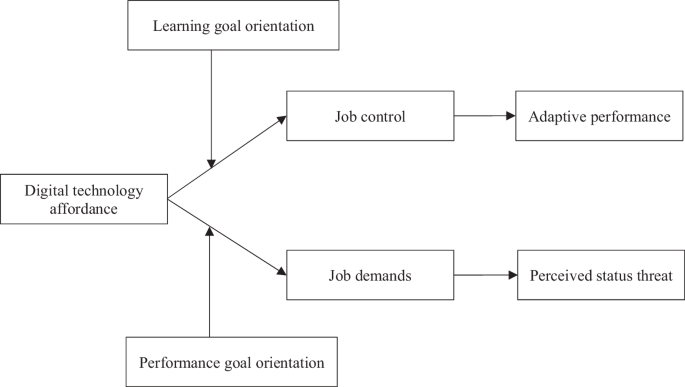
Based on the dual-path proposition provided by the JD-R theory, we attempt to explore the possible paradoxical and double-edged sword effect of DT affordance on employees. We argue that technological innovations and management updates, along with digital transformation, reflected in DT affordance, would bring about changes in the working environment. Such changes will affect outcomes on the individual end through job demands and job control, respectively.
DT affordance: a double-edged sword for employees
Employees may perceive DT affordance as enhancing job control, thereby promoting their adaptive performance. First, the multifunctional nature of DT affordance empowers employees by enabling them to effectively leverage features such as automated processing, intelligent analytics, and real-time collaboration. Consequently, employees are likely to develop enhanced self-efficacy regarding digital technologies, allowing them to address complex task demands with greater efficiency and stronger problem-solving capabilities (Wang et al. 2021), thereby improving their adaptive performance. Second, the usability and learnability embodied in DT affordance provide employees with crucial psychological buffering in times of organisational change (Edmondson and Bransby 2023). When technology interfaces are intuitive and the learning curve is gentle, employees are more likely to overcome technophobia and quickly develop a sense of mastery and confidence in using new systems (Park and Park 2021). The accumulation of such psychological capital enables employees to adopt a more positive attitude toward change. Third, digital technologies facilitate access to information, remote collaboration, and personalised configurations, which enhance employees’ job autonomy (Huu 2023; Nelson et al. 2017), increase their work engagement, and ultimately contribute to higher adaptive performance.
Conversely, employees may also perceive DT affordance as increasing job demands, leading to increased perceived status threat. First, when digital technologies exhibit powerful automation and intelligence, employees are required not only to master existing functions but also to continuously learn new systems (Schwarzmüller et al. 2018). This ongoing need for skill upgrading may increase their psychological burden and provoke anxiety (Bakker and Demerouti 2017). Second, digital technologies may substitute tasks previously performed by humans, thereby leading employees to question the value of their own roles (Belitski et al. 2023). This is particularly salient for employees who have established their organisational standing based on experience and judgement. High DT affordance may be interpreted as a status threat signal, implying that technology could replace their professional authority and influence within the organisation. Third, DT affordance may quantify skill disparities and reconstruct promotion criteria, intensifying internal competition for status and triggering employees’ anxiety regarding their organisational standing (Cameron and Green 2019; Chatterjee et al. 2020).
Moderating role of goal orientation
Given that DT affordance reflects the supportive conditions that digital technology provides for individuals to achieve their goals and the realisation of DT affordance depends on the interplay between digital technologies, users, and their operationalisation approaches (Mora et al. 2021; Nambisan et al. 2019), employees’ goal orientation may shape their perception of DT affordance, thereby generating divergent outcomes. Moreover, the JD-R model emphasises that personal resources (e.g., optimism, self-efficacy) and personal demands (e.g. goal setting, levels of expectations) may play a moderating role in both health-impairment and motivational pathways (Bakker and Demerouti 2017). Therefore, we introduce goal orientation as a crucial moderating variable to explore different responses of employees in the same technological environment. We propose that employees with different goal orientations will have different perceptions of job demands and job control when dealing with DT affordance, which will in turn have differential impacts on subsequent behaviours.
According to Dweck and Leggett (1988), as a stable individual trait, goal orientation will affect whether employees pay more attention to the results of work performance (i.e. performance goal orientation) or the harvest of work process (i.e., learning goal orientation) when completing work tasks. The difference in goal orientation determines whether employees adopt active or passive strategies for DT affordance.
Learning goal orientation will strengthen the positive effect of DT affordance on employee job control. Specifically, employees with a learning goal orientation believe that their capabilities are malleable. Even in unknown fields, individuals can develop their capabilities by constantly acquiring new knowledge (Jones et al. 2021) and match their abilities with the job requirements, thereby effectively tackling work-related challenges (Wang et al. 2024) and improving their non-cognitive abilities (Gao and Feng 2024). Digital workplaces provide employees with more flexible and personalised learning opportunities. Employees with high learning goal orientation are more likely to regard the changes brought by DT affordance as opportunities for personal growth, development, and career advancement (Schneider and Sting 2020). These individuals also have strong intrinsic motivation to pursue competency growth (Ma et al. 2021). They are inclined to take the initiative in acquiring digital knowledge, show more intrinsic interest, and devote more energy and commitment to digital tasks. This increased engagement enhances their understanding of enterprise digital capabilities (Zhou et al. 2024), prompting them to experience more autonomy and a sense of responsibility in work. However, employees with low learning goal orientation are less likely to actively explore and experiment with the new features or ways of operating provided by digital technologies, thus limiting the new skills and experiences they have accumulated in the process of using them.
In contrast, employees with a performance goal orientation believe that their capabilities are relatively fixed and uncontrollable (Ma et al. 2021). They are inclined to worry about their potential failure in achieving performance goals and meeting evaluation requirements in the process of learning new knowledge and adapting to new tasks. Thus, they are more inclined to participate in work tasks with deterministic returns during digital transformation. When the results of work are unpredictable, employees’ motivation and effort to cope with changes will decline (Yildiz et al. 2021). The uncertainty arising from DT affordance will weaken their work motivation. Moreover, employees with high performance goal orientation are more sensitive to external evaluations (Ma et al. 2021; Vandewalle 1997). When confronted with digital technology, they are likely to focus on the process visualisation, data quantification, and performance tracking features of the system, interpreting these as a new form of appraisal pressure. Employees with low performance goal orientation are less concerned with comparing themselves to others and are less likely to view digital technology as a competitive tool. Therefore, high performance goal-oriented employees experience a higher cognitive load and psychological pressure related to the complex challenges and uncertain risks of DT affordance and tend to actively avoid challenging tasks. Thus, we propose the following:
Hypothesis 1: Employees’ learning goal orientation moderates the relationship between DT affordance and job control, such that the relationship is more positive for employees with higher (vs. lower) learning goal orientation.
Hypothesis 2: Employees’ performance goal orientation moderates the relationship between DT affordance and job demands, such that the relationship is more positive for employees with higher (vs. lower) performance goal orientation.
Job control and adaptive performance
We postulate that the positive component of the double-edged impact of DT affordance on employees is reflected in the enhanced adaptive performance induced by the improvement in job control. Adaptive performance focuses on whether employees actively respond to changes in work tasks. It also reflects employees’ adaptability and actual performance in complex and dynamic work environments (Park and Park 2019).
Considering the novel challenges in employees’ jobs during the digital transformation, exploring the relationship between DT affordance and employee adaptive performance has important implications. Previous studies have shown that job-related factors such as decision-making autonomy, work resources, job uncertainty, and role change will affect employees’ adaptive performance (Park and Park 2019). For example, job uncertainty instigates work pressure and deteriorates employees’ adaptive performance (Sherehiy and Karwowski 2014). When employees have more autonomy in work decisions, they are more likely to take the initiative to deal with various uncertain work tasks, thereby exerting a positive impact on adaptive performance (Goštautaitė and Buciuniene 2015).
Job control indicates whether employees can influence the work task and decide how to complete the work independently (Cheung et al. 2015). According to the motivational path of the JD-R model, high job resources foster motivation, resulting in positive psychological and behavioural consequences (Bakker et al. 2007; Bakker and Demerouti 2017). Job control, as an important job resource, has a significant positive impact on employees’ willingness to adapt actively to job changes (Sargent and Terry 1998). Job control can stimulate employees’ intrinsic motivation and enhance their perception of work meaningfulness. It indicates that employees are willing to take more responsibility for their work (Zhou et al. 2024). Furthermore, Park and Park (2021) have proven that learning new tasks, technologies, and procedures is an important dimension of adaptive performance. Employees who have a greater sense of control over their work are more willing to devote their energy to active learning activities to adapt to the job challenges engendered by DT affordance. Therefore, they noted that job control can promote employees’ active learning behaviour and thus enhance adaptive performance. Therefore, we propose the following:
Hypothesis 3: During enterprise digital transformation, job control is positively related to adaptive performance.
Job demands and perceived status threat
We postulate that the negative component of the double-edged impact of DT affordance on employees is reflected in the increase in employees’ perceived status threat through increased job demands. Based on the JD-R model, the increase in job demands means that employees need to pay more physical or psychological resources to cope (Bakker and Demerouti 2017). Extant research shows that workload, emotional exhaustion, and time pressure (Downes et al. 2021; Gonzalez-Mulé et al. 2021) may trigger anxiety in employees. Even as employees strive to meet higher job demands, the depleted energy cannot be recovered quickly, leading to negative consequences such as burnout, job fatigue, and role conflict (Wu 2016). These adverse impacts make employees feel their status is threatened by DT affordance.
Moreover, employees tend to generate a stronger sense of insecurity from DT affordance, which may arise from doubts about automation, fears of incapacity, a sense of alienation from work, loss of control over digital systems, and worry about job loss (Schneider and Sting 2020). All of these will impoverish employees’ belief in their daily work and generate perceived status threats. Thus, we posit the following:
Hypothesis 4: During enterprise digital transformation, job demands are positively related to perceived status threat.
Moderated mediation model
Drawing from the rationale of the JD-R model, this study conceptualises the changes in the working environment and the pressure caused by DT affordance as both opportunities and challenges for employees. The double-edged sword effects manifest via job control and job demands. Given individual differences in learning and performance goal orientations, DT affordance may elicit either positive or negative evaluations of digital transformation, which ultimately lead to different impacts on employees.
Employees with a learning goal orientation can more easily understand the significance of DT affordance from a positive viewpoint. They regard DT affordance as an opportunity for personal learning and development and develop their capabilities by continually learning new things (Jones et al. 2021). They are more likely to recognise the value of digital technology’s automation, information processing, decision support, and other functions, and thus utilise them to enhance efficiency and capability. Thus, their job control will increase, helping them adapt more quickly to work changes (Wang et al. 2024), and further enhance flexibility and creativity in task completion. Furthermore, high learning goal-oriented employees are more likely to accumulate self-efficacy from technology use, that is, intensify the belief that they are capable of performing complex tasks. As they become more proficient in digital technology use, they gradually increase their psychological security and ability to cope with change (Huu 2023; Liu et al. 2024). This accumulation of psychological capital improves their adaptive performance in uncertain and complex work environments (Liu et al. 2024).
In contrast, employees with a performance goal orientation are more inclined to regard DT affordance as an extra requirement and superimposed work pressure. Since they avoid exposure to failure and are highly concerned with comparisons with others (Cellar et al. 2011; Utman 1997), they may worry about failing to master complex digital technologies and being outperformed by coworkers, creating a sense of relative deprivation and status anxiety (Cameron and Green 2019; Chatterjee et al. 2020). When high DT affordance leads to changes in organisational structure, task processes, or evaluation mechanisms, employees with high performance goal orientation may worry that the original position built on experience, seniority, or connections is undermined by the new technology (Wang et al. 2021), thus feeling their relative advantages in the organisation weakened and forming an obvious sense of status threat. Thus, we propose:
Hypothesis 5: Employees’ learning goal orientation moderates the mediating effect of DT affordance on adaptive performance through job control, such that this mediation effect is more positive for employees with higher (vs. lower) learning goal orientation.
Hypothesis 6: Employees’ performance goal orientation moderates the mediating effect of DT affordance on perceived status threat through job demands, such that this mediation effect is more positive for employees with higher (vs. lower) performance goal orientation.
link