
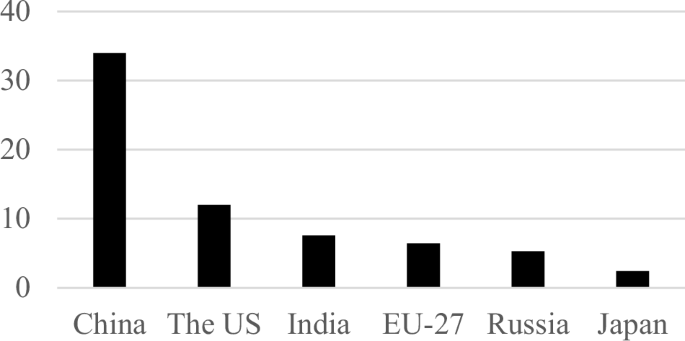
In the empirical part of our research paper, the starting step includes performing the CD and heterogeneity tests. Hence, LM (Lagrange Multiplier) (Breusch and Pagan, 1980), LM CD (Pesaran, 2004), and LMadj. (Pesaran et al., 2008) tests are first performed, and their outcomes are displayed in Table 4. The H0 hypothesis, which posits CD independence, is disapproved at a 1%, uncovering the CD presence among CO2E, BUS, LEGAL, PROP, INCOME, and URB.
The presence of homogeneity is secondly examined by means of delta tilde tests of Pesaran and Yamagata (2008) and their outcomes are demonstrated in Table 5. The H0 hypothesis, which posits homogeneity, is rejected at 1%, and the presence of heterogeneity is uncovered. In conclusion, utilization of econometric techniques considering the CD and heterogeneity is essential for reliability of the results.
The presence of unit root at the series of CO2E, BUS, PROP, LEGAL, INCOME, and URB is analyzed through PANKPSS unit root test with structural breaks developed by Carrion-i-Silvestre (2005) and Carrion‐i‐Silvestre at al. (2005) considering the presence of economic crises during the 2000–2021 period. The results presented in Table 6 uncover that the level values of all series have unit root because test statistics are found to be greater than critical values. But the first-differenced values of these variables do not include unit root. Furthermore, the results also uncover that especially 2008 global financial crisis, the Eurozone sovereign debt crisis, and national crises led structural breaks at the series.
The cointegration nexus amongst CO2E, BUS, PROP, LEGAL, INCOME, and URB is investigated by way of Westerlund and Edgerton (2008) cointegration test with structural breaks and its outcomes are displayed in Table 7. The outcomes of the test uncover a stable long-term relationship amongst the series, because H0 hypothesis of the test, which posits an insignificant cointegration nexus amongst the series, is rejected as p-value is lower than 5%. Furthermore, the results of the Johansen Fisher cointegration test in Table 8 uncover that there exist five significant cointegration relationships among the series.
The AMG estimator by Eberhart and Bond (2009) is utilized to specify the long-term coefficients of panel and BRICS-T countries, and the coefficients are displayed in Table 9. The panel coefficients demonstrate that the legal system negatively impacts CO2 emissions while income positively affects CO2 emissions. Furthermore, the coefficients of the BRICS-T countries demonstrate a positive influence of market-oriented business regulations on CO2 emissions in Brazil, China, India, and South Africa. On the other hand, improvements in property rights decrease the CO2 emissions in Brazil, China, and India and improvements in legal system decrease the CO2 emissions in Brazil, China, India, South Africa, and Türkiye. In addition, income has a positive impact on CO2 emissions in China, India, Russia, South Africa, and Türkiye and urbanization positively impacts CO2 emissions in China, India, South Africa, and Türkiye.
Business regulations set the environment which the firms operate in and the procedures for the start of new firms. Therefore, business regulations can impact CO2 emissions through economic activity level in a country, but the effect of business regulations on CO2 emissions can vary depending on the stringency of environmental policies in force and economic development levels of the countries. Thus, Gani and Sharma (2009), Rieger (2019), and Sezgin et al. (2024) also uncovered a positive effect of positive business environment on CO2 emissions while Güney (2024) unveiled a negative effect of business climate on CO2 emissions. However, our results indicate that business regulations positively affect CO2 emissions in Brazil, China, India, and South Africa in the long-term incompatible with the findings of Gani and Sharma (2009), Rieger (2019), and Sezgin et al. (2024). The positive effect of business regulations on CO2 emissions can be resulted from the relatively looser environmental policies because the environmental performance indices of Brazil, South Africa, China, and India in 2024 are respectively 53.00, 42.7, 35.40, and 27.60 (Yale Center for Environmental Law & Policy 2024). Furthermore, the average value of environmental policy stringency index of Brazil, China, India, and South Africa out of 6 over the 2000–2020 period is 0.538, 1.602, 1.782, and 0.717 (OECD 2025). In conclusion, our findings support the validity of the first hypothesis of the study based on the associated literature.
On the other hand, property rights can contribute to environmental protection through multiple channels at theoretical terms. The protection of property rights encourages entrepreneurs and firms to develop green production methods and green or energy-efficient technologies. Furthermore, property rights can contribute to environmental quality through internalization of costs related to environmental pollution. The limited empirical literature including Kerekes (2011), Donis et al. (2023), and Viglioni et al. (2024) also uncovered the findings supporting these theoretical expectations. Similarly, our results also indicate that improvements in property rights decrease the CO2 emissions at panel level and in Brazil, China, and India incompatible with the associated literature. In conclusion, our results support the validity of the second hypothesis of the study based on the associated literature.
The theoretical views on the nexus between the legal system and environment indicate that the legal system can impact CO2 emissions via different channels. On the one hand, the improvements in rule of law can contribute to the environmental protection through supporting the stringency of environmental policies and adoption of circularity by the firms (Fredriksson and Mani 2002; Losa 2025). On the other hand, it can negatively impact the environment through raising the corruption level (Fredriksson and Mani 2002). In addition, an effectively functioning legal system can decrease CO2 emissions by increasing compliance with environmental regulations. In line with these theoretical considerations, the empirical studies have also reached different results. In this context, Fredriksson and Mani (2002), Mahmood and Alanzi (2020), Muhammad and Long (2021), Khan et al. (2023), and Stef et al. (2023) discovered a negative effect of rule of law on CO2 emissions while Abid (2016) and Mahmood et al. (2022) discovered a positive effect of rule of law on CO2 emissions. Our findins indicate that improvements in legal system negatively impact CO2 emissions in Brazil, China, India, South Africa, and Türkiye incompatible with the results of Fredriksson and Mani (2002), Mahmood and Alanzi (2020), Muhammad and Long (2021), Khan et al. (2023), and Stef et al. (2023). In conclusion, our findings verify that negative effects of legal quality on CO2 emissions outweigh the positive effect of legal quality on CO2 emissions and support the validity of the third hypothesis of the study based on the associated literature.
The relationship between income and CO2 emissions is one of the most explored topics in the literature. However, the effect of income on CO2 emissions can be changed depending on economic development level and environmental policies in force and environmental awareness in a country. The related empirical literature has also reached mixed results similarly to these theoretical considerations. In this regard, Akbostancı et al. (2009) and Awan and Azam (2022) respectively revealed a N interaction and an inverted U interaction between income and CO2. In addition, Sharma (2011), Abid (2016), Aller et al. (2021), Zhao et al. (2022), Onofrei et al. (2022), Ali et al. (2023), Arshad and Parveen (2024), and Mukhtarov et al. (2024) revealed a positive relationship between economic indicators and CO2 emissions. In a similar vein, our findings also unveil a positive relationship between real GDP per capita and CO2 emissions at panel and in China, India, Russia, South Africa, and Türkiye and this positive effect probably resulted from loose environmental regulations in force during the study period. In conclusion, our findings support the validity of the fourth hypothesis of the study based on the associated literature.
Lastly, the effect of urbanization on CO2 emissions can also be different depending on the EKC hypothesis and the positive effect of urbanization on CO2 emissions can be negative at further economic development due to increasing economic activities with low emissions. Thus, Khoshnevis Yazdi and Dariani (2019), Aller et al. (2021), Amin et al. (2022), Luqman et al. (2023) and Arshad and Parveen (2024) uncovered a positive effect of urbanization on CO2 emissions while Sharma (2011) uncovered a negative effect of urbanization on CO2 emissions incompatible with these theoretical considerations. Our results also indicate that urbanization positively impacts CO2 emissions in China, India, South Africa, and Türkiye. In a similar vein, loose environmental policies in these countries account for the positive interaction between urbanization and CO2 emissions. In conclusion, our findings support the validity of the fifth hypothesis of the study based on the associated literature.
The causal nexus amongst CO2 emissions, business regulations, property rights, rule of law, income, and urbanization is analyzed in the sample of BRICS-T for the 2000–2021 duration by way of the JKS (2021) causality test and the consequences of the test are demonstrated in Table 10. The results indicate a feedback interaction amongst business regulations, property rights, urbanization and CO2 emissions and a unilateral causality from income to CO2 emissions in the short term, but insignificant nexus between rule of law and CO2 emissions.
The causal nexus amongst CO2 emissions, business regulations, property rights, and rule of law only by Sezgin et al. (2024) and Viglioni et al. (2024). On the one hand, Sezgin et al. (2024) unveiled a bidirectional causality between business climate and CO2 emissions. On the other hand, Viglioni et al. (2024) disclosed a bilateral causal interaction between property rights and CO2 emissions. Therefore, the results of both Sezgin et al. (2024) and Viglioni et al. (2024) support our findings. Furthermore, a unidirectional causality from GDP per capita to CO2 emissions uncovered by Wang et al. (2020) for central and eastern provinces of China, Topcu et al. (2016) and Balli et al. (2020) for Türkiye support our significant causality running from income to CO2 emissions for the BRICS-T economies. Last, Khoshnevis Yazdi and Dariani (2019) revealed a bidirectional causal nexus between urbanization and CO2 emissions in Asian countries similar to our results, but both Topcu et al. (2016) and Musa et al. (2021) respectively unveiled a unilateral causality from urbanization to CO2 emissions for Türkiye and Nigeria.
link